
ADDING ONLINE CLASSES TO YOUR STUDIO: WHAT WORKS, WHAT DOESN’T, AND WHERE TO START
This article was written by our partners at OfferingTree, a business management platform built for yoga and Pilates studio owners. As part of our ongoing content partnership, they've contributed this practical guide on hybrid studio models — a topic we hear about constantly from wellness business owners navigating the shift.
By Katie Nissley
Every year, a handful of your best members disappear. They move cities, change jobs, have kids, get pulled in directions that make Tuesday night class impossible. You lose the relationship and the revenue, and there isn't a graceful way to hold onto either if everything you've built lives inside a physical space.
An online membership doesn't solve everything, but it gives people a reason to stay.
Why successful studios are adding online — and why now
Member habits changed after COVID and haven't fully recovered. According to HFA data, average weekly attendance dropped from 2.1 visits per week in 2019 to 1.5 visits in 2024. Members might be going to classes less often, but they're still investing in their health. Instead of attending their favorite 6pm HIIT class daily, they started mixing in other options like home workouts, on-demand classes, and outdoor exercise.
Members expect flexibility. Global fitness memberships climbed 6% year-over-year in 2024, while the virtual fitness market is projected to grow by 30.5% through 2033. The direction is clear. In-person-only studios are getting a smaller share of members' weekly fitness time. Offering both options keeps them longer.
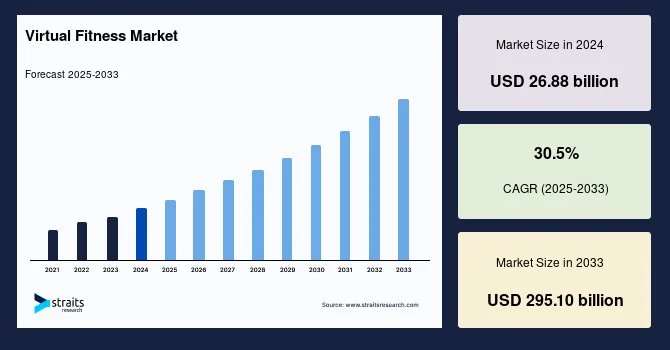
Source: Straits Research
Revenue has plateaued. There are only so many hours in the day and only so much space in your studio. An online membership opens new revenue that doesn't require adding more classes to your schedule.
It improves retention. Studios that offer flexible membership including hybrid options retain more members. Hybrid members stay three months longer on average, and 85% of members now expect some form of digital access. Samantha Harrison, owner of Yoga Strong NC in Greenville, North Carolina uses the virtual library as a selling point.
"As soon as people say 'I'm gonna be gone for a week this month', it's like, 'no problem. We'll record it for you.'"
The library removes the reasons people hesitate to commit and keeps them coming back.
Going hybrid protects against the next disruption. Samantha was one of the first studio owners in her area to pivot online during COVID. She saw the writing on the wall and didn't want to wait to see what would happen.
"I didn't wait for everything to get closed down. I pretty much quickly saw what was happening and was like, okay, we're making the pivot."
Over time, she improved her process and tech, and could see how much her members valued it. So much so that when she opened her second yoga studio, she decided to keep the virtual option.
If you don't offer it, they'll find it elsewhere. Hybrid fitness participation is up 41% year-over-year. With apps like Apple Fitness+, Peloton, and free YouTube videos, members are seeking a variety of options and don't just want to choose online or in person. When you offer an online membership, you can adapt to your member's lifestyle and phases.

Source: Men’s Health
Who your online membership is for
At first, Samantha assumed her virtual classes would mostly attract her existing members looking for flexibility. But, it turns out that her in-person and online audiences are quite different. Yes, some members join virtually when they travel or when they're sick, but she also has students who live locally and still prefer to practice online.
"Sometimes those people just don't feel comfortable coming in, or maybe they have an injury and they want to be in the comfort of their own home making their own modifications."
And then there are the members who moved away, who go on retreats and want to keep practicing, or who found Yoga Strong online and have never set foot in Greenville.
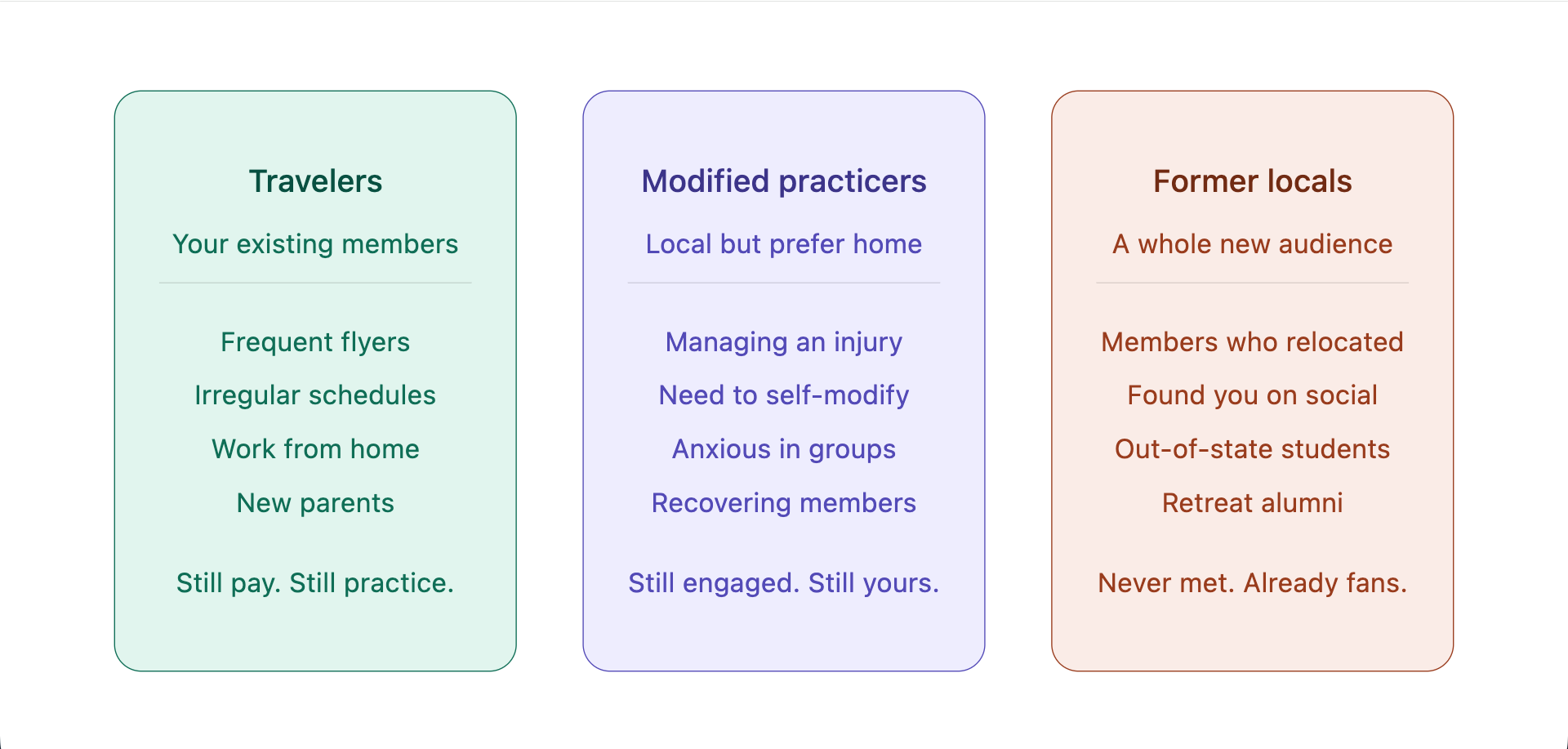
Consider: Who already follows or engages with you online but has never walked through your door? Who has reached out asking whether you offer anything virtual? And if a client moved away tomorrow, would they pay to keep practicing with you remotely?
The operational reality
It's 6am. Twelve members are in your Vinyasa Flow class, and four on the livestream. Your teacher starts class, and the microphone cuts out twenty minutes in. The people at home have been watching a silent yoga class, reading lips and guessing cues. By the time the teacher notices, it's already too late. After class, you send an apology email and offer a credit.
Samantha knows this scenario. In the early days of going hybrid, she was handholding students through downloading Zoom, talking them through how to join class, and helping them find the mute button.
"In the beginning we just had to message students afterward and be like, I'm so sorry, thanks for your patience."
It wasn't pretty, but it worked. She couldn't have anticipated everything that would go wrong, but now when something breaks, there's already a plan for it.
Better equipment doesn't prevent tech issues. Even the best microphone and the strongest WiFi signal have bad days. What makes hybrid sustainable is knowing in advance what you'll do when something goes wrong. Now Samantha's front desk staff monitors the stream during every virtual class. If the audio drops, they catch it within minutes and switch to a backup microphone. Nobody loses their class or feels abandoned.
Samantha's biggest regret isn't the tech, it's waiting too long to hire admin help.
"I always thought I couldn't afford it. But actually we can make a lot more money because I can do more things and they can focus on that. I wish I would have made that leap sooner."

She now has two full-time administrative staff and six part-time front desk staff — including someone who monitors the live stream during every class and troubleshoots tech issues in real time. Now the hybrid side of the business runs without her having to hold it together.
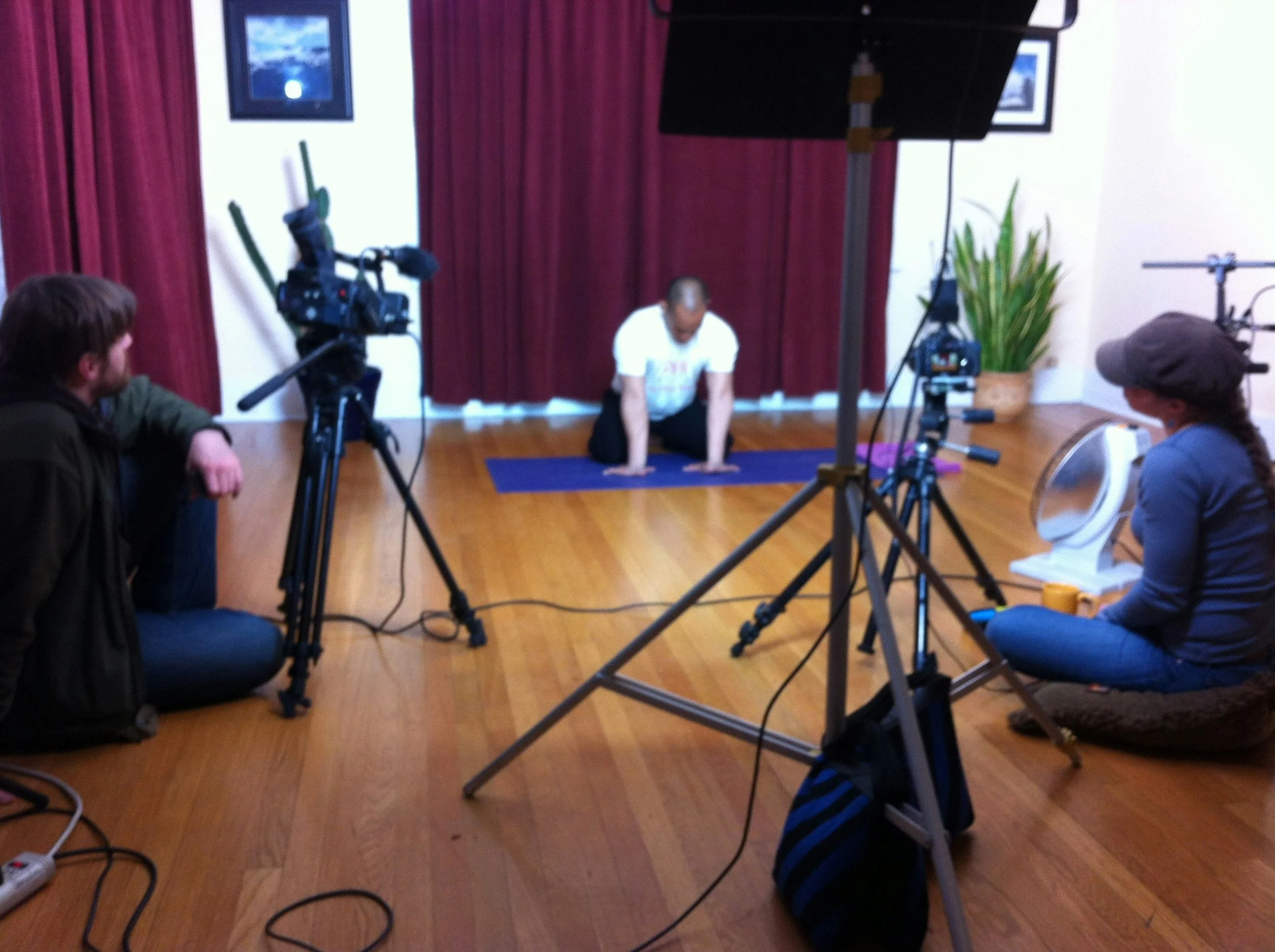
Instead of researching a bunch of different cameras, microphones, and software, Samantha recommends getting recommendations from a local professional. She hired a videographer who specified everything she needed: the camera, the soundboard, the mics. It may have cost more upfront, but the video and audio quality that your members care so much about will be worth it in the end.
Pricing it right
Online memberships get underpriced because digital content feels like it should cost less than showing up in person. Samantha disagrees.
She charges the same drop-in price for virtual and in-person classes.
"It's a lot of time and manpower. I have a whole staff member here to support this. Even though they're not getting the same in-person experience, I think the convenience for them and all of the extra things we do to make their experience really good is worth it."
She currently offers an on-demand only membership for $25 per month and is building a dedicated virtual-only membership that includes live class access, workshops, and the on-demand library. The tiered structure gives online members an option built just for them, and the studio a path to more revenue from an existing channel. Fitness studio software like OfferingTree makes it straightforward to set up tiered membership pricing, automate billing, and manage both your in-person and online offerings without juggling multiple tools.
Choosing the right tools
You probably already have studio software for scheduling, memberships, and billing, but when you start offering online classes, it adds a level of complexity that not all softwares can handle.
Samantha started with a process that added hours of work per day across all of her classes. It just wasn't built for what she was trying to do. When the tool doesn't fit the job, the gap lands on your team, every day, for every class.
When evaluating any studio management platform, ask three questions:
1. Can it handle two membership types with different access rules and billing cycles, independently?
2. Can members self-manage their own access (updating payment information, pausing memberships, accessing content) without contacting your front desk?
3. How does a recorded class actually get from the camera to the member? Count the steps. More than three and it starts becoming a burden.
The case for consolidation
Rachel Scott, a yoga teacher trainer and OfferingTree user, was running livestream classes, a pre-recorded content library, and a membership all through separate tools that didn't talk to each other. Registrations lived in one place, Zoom links in another, billing somewhere else, and the patchwork was eating the time she could have been spending on teaching. She needed it all in one place.
Every tool you add to your stack is another login, another thing your staff has to learn, and another silo where your data lives. Studio management software like OfferingTree is built to handle memberships, scheduling, payments, and communication for a hybrid studio, so you can focus less on the admin and more on your members.
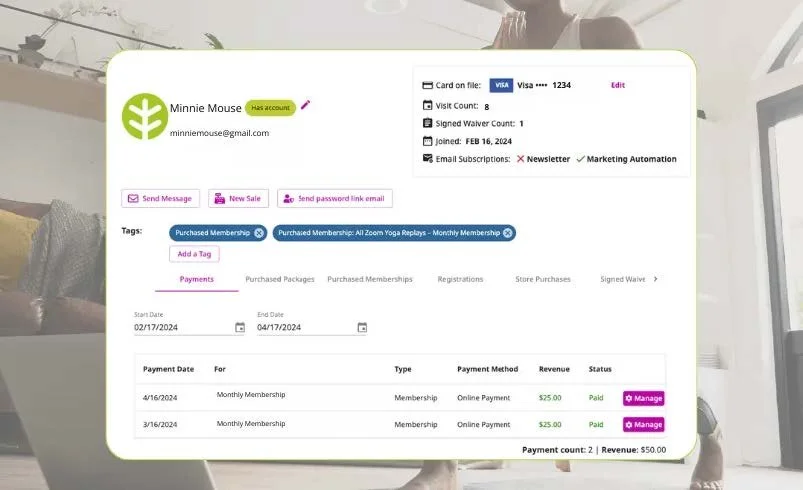
Before you evaluate studio management platforms, write down what you actually need them to do, and who on your team will do each piece. Samantha runs a sophisticated hybrid operation across 24 classes a week, and it works because she built clear processes: who monitors the live stream, who adds recordings to the library, who gets class links into member emails before each session, and what happens when something breaks.
How to market your hybrid classes
Marketing a hybrid studio is not the same as marketing a brick-and-mortar-only studio business. You're managing two different audiences with different needs. Here's how the approach changes.
The studio is the primary draw for your local audience. Make sure your members know online membership is an option, but always lead with marketing in-person classes first. Mention it in your emails, on your website, and at the front desk.
For your online offerings, you need to be very clear about your offerings. Get specific about your offering. "Live virtual yoga and strength training for women over 40 who want to feel stronger" will help you better reach the people you want to attract.
A simple framework for writing your positioning: answer three questions in plain language.
Who specifically is this for? Not "anyone who wants to practice yoga" — name the person. Their age, situation, what they're dealing with, what they've tried before.
What does your online membership give them that a YouTube channel doesn't? Maybe it's live instruction with real corrections. Maybe it's the community. Maybe it's the accountability of showing up to a scheduled class. Pick the one that's most true for your studio and lead with it.
What makes your approach different from the next result in their search? Your teaching style, your format, your niche, your community — something specific to you that someone else can't replicate by copying your class schedule.
If you can't answer all three, you're not ready to write the marketing copy yet. For more on building that foundation, the Kōvly Studio journal covers brand and marketing strategy for wellness businesses in depth.
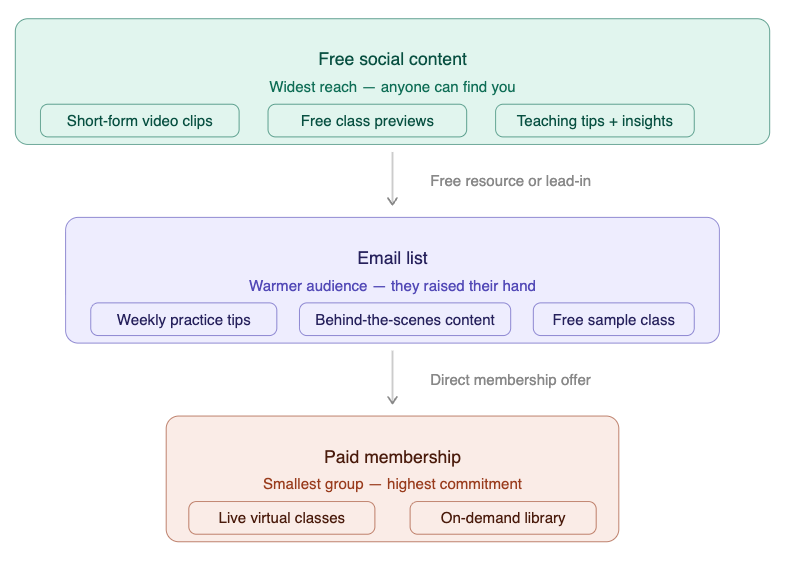
In-person studios get members through walk-ins, referrals, and local visibility. Online memberships grow through content — social media, email, YouTube, podcasts, and collaborations with other creators. Your instruction style, your perspective, your personality — these are what an online audience uses to decide if they want to practice with you. If you're not creating content that demonstrates what it's actually like to be in your virtual class, you're asking people to make a purchasing decision with almost no information.
This is the part where a lot of studio owners check out. Nothing about your classes has to change. Your instructor who teaches a great class on Tuesday morning already has the content. You're just making it visible to more people.
Most solo owners spend three to five hours a week managing the online side once it's running smoothly. Start small: one piece of content per week, repurposed from what you already teach. Film a 60-second clip from class, post it to Instagram, add the full version to your membership library. That's the minimum viable content strategy. Build the habit before you build the audience.
Samantha takes this further every Black Friday with what she calls the Yoga Feast, a one-time sale of the entire year's recordings for $199.
"Every year I keep offering it and it just keeps doing great. It reaches people outside the membership, introduces new students to what Yoga Strong offers, and monetizes content that already exists."
Your library has more value than the members currently paying for it.
Keeping online members once you have them
In the studio, members form bonds with each other naturally. They cheer each other on, connect over shared goals, and hang out after class. Members who attend group fitness classes end up keeping their membership 22% longer. Online classes don't always have the same effect, so you have to be more deliberate about community building.
Samantha greets virtual attendees by name in the chat. If she knows an online member knows someone in the studio, she brings the mic over so they can say hello. She calls out modifications specifically for people at home. These might seem like small things, but they make the people practicing at home feel like they're included and in community.
The specifics will look different for every studio, but the goal is to make online members feel like they're part of a community.
For online members, email is often the only consistent touchpoint between classes. Before you launch your online membership, build these three things: a three-email welcome sequence in the first week, one community touchpoint per week, and a re-engagement message when someone misses two sessions in a row. Don't wait to build it until you notice people leaving.
Where to start
Write three sentences: who your online membership is for, what it's solving, and why you specifically are the right person to help them. If you can write those clearly, you're ready to build.
Before you record a single class, tell your existing members it's coming. Gauge interest, presell if possible, and let real demand shape what you create. Set up the infrastructure — memberships, billing, content library — using a studio software built for both online and in-person, like OfferingTree, so the admin is handled from day one.
The audience for your studio is bigger than your zip code, and a hybrid model is how you reach them.
ADDED BY KŌVLY STUDIO
This article was contributed by OfferingTree as part of an ongoing content partnership with Kōvly Studio. Kōvly Studio is a boutique brand and marketing agency for independently owned wellness businesses. If you're ready to build the brand foundation that makes your marketing actually work, take our Marketing Assessment or explore our 2026 Health + Wellness Marketing Report.